


What happens when you get injured at work?
We all go to work each day expecting to come home to our families healthy and safe, but accidents can occur, and unfortunately, workers sometimes get injured in the process of performing their duties. If you get injured at work, the first thing you should do is immediately seek appropriate medical treatment and then call your families and notify them of your status.
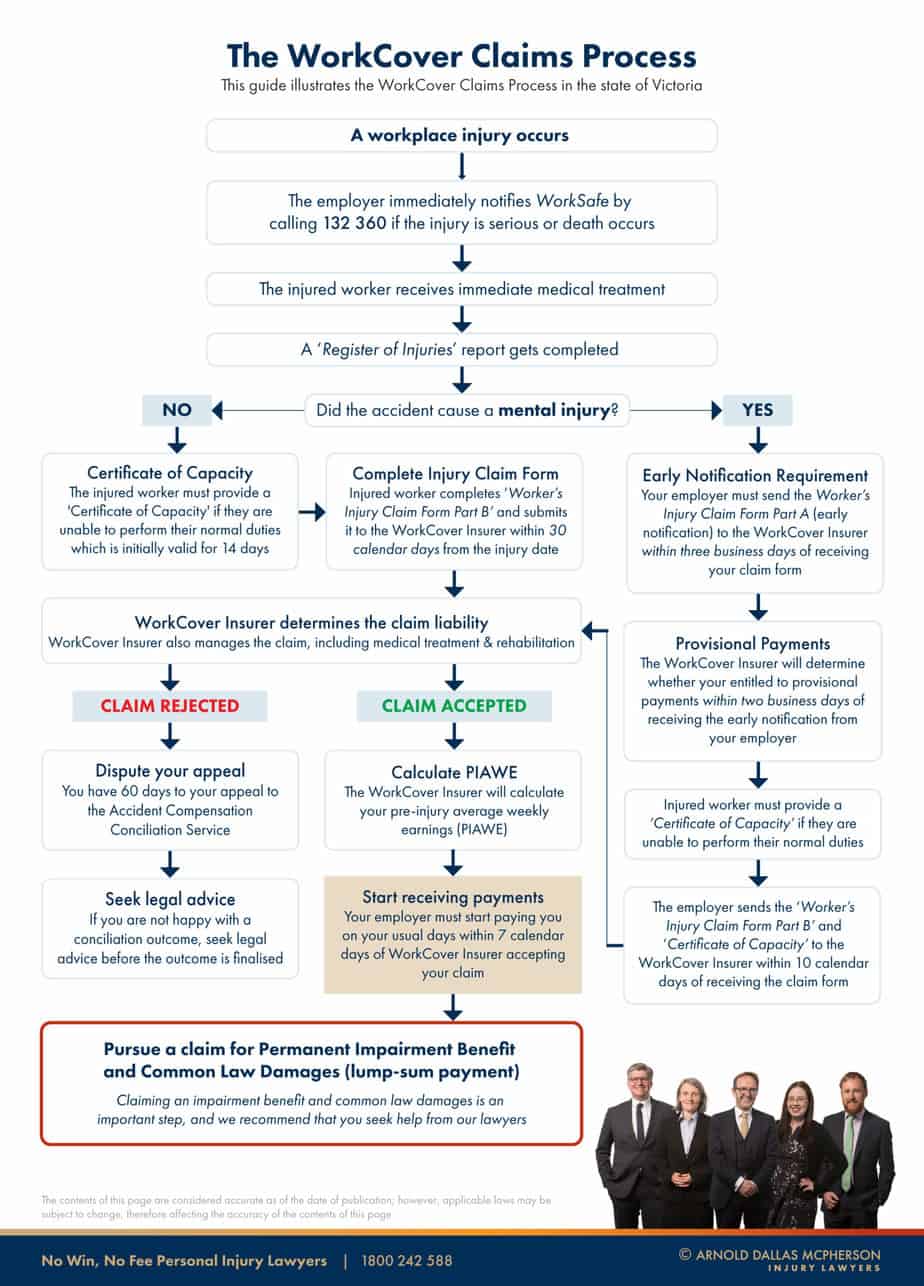
How long do I have to make a WorkCover Claim?
You will need to notify your employer within 30 days of sustaining a work-related injury, or within 30 days of becoming aware of a work-related injury or illness. This notice should be given in writing to your employer so they can make an entry in the workplace Register of Injuries.
If you have not reported your injury within 30 days, you may still be able to lodge a WorkCover claim and have it accepted. Consult with one of our personal injury solicitors before lodging a claim so we can review the circumstances and advise you whether you still have a viable claim.
Frequently Asked Questions About the WorkCover Claims Process
WorkCover claim forms are available online from WorkSafe Victoria, the Victorian WorkCover Authority. You can also request a physical form from your employer or pick one up at the local post office.
Arnold Dallas McPherson Injury Lawyers (ADM) are available to answer your questions, help you complete the paperwork and provide you with knowledgeable legal representation. Contact us online or call 1800 242 588 today.
First, you should get medical attention and report the injury to your employer. If you are unable to work and need to claim weekly payments for lost earnings, you will need to obtain an initial Certificate of Capacity from a medical practitioner. You will then need to complete Part A of the Worker’s Injury Claim Form, which you can submit online through the WorkSafe Victoria website. Alternatively, you can download the form, complete it and submit it to your employer.
Making a WorkCover claim on your own can be challenging. We recommend seeking legal guidance before lodging your claim to ensure that your legal rights and entitlements are protected.
WorkCover is Victoria’s workers’ compensation scheme. Employers in Victoria are required to register for workers’ compensation insurance. If a Victorian worker is injured or becomes ill because of their work, they can usually make a claim through WorkCover, though some employees are covered by the federal Comcare scheme.
Authorised WorkSafe insurers manage WorkCover claims. If your claim is accepted, WorkCover will pay for treatment expenses, weekly payments if your injury affects your ability to work and other statutory benefits. You may also qualify for a permanent impairment benefit and common law damages if a work-related injury or illness meets certain criteria.
We discuss the workers’ compensation process in Victoria in detail on our blog. If you need assistance or are concerned about navigating the WorkCover claims process, reach out to ADM straight away.
The benefits and additional compensation you can claim through WorkCover depend on your individual circumstances. You may be entitled to:
- Medical and like services: WorkSafe pays the reasonable cost of necessary medical treatment and support services for work-related injuries and occupational illnesses.
- Weekly payments: You are entitled to a fixed percentage of your pre-injury average weekly earnings (PIAWE) if a work injury prevents you from working or limits the work you can do.
- Provisional payments: If you sustain a mental injury due to your work, provisional payments will cover treatment and mental health support for up to 13 weeks — even if your WorkCover claim is ultimately rejected.
- Superannuation payments: If you remain eligible for weekly payments after 52 weeks, you are also entitled to superannuation contributions.
- Permanent impairment benefit: This additional benefit pays a lump sum if a work-related injury or illness causes permanent impairment. Your injury must be assessed as meeting the minimum level of impairment to qualify.
- Common law damages: You may be entitled to common law damages if the negligence of your employer or another party caused you to suffer a serious work-related injury. WorkCover common law damages compensate you for economic and non-economic loss associated with serious injuries.
WorkCover may also provide compensation and support to family members and dependants following a work-related death. This may include medical and like services prior to the worker’s death, the cost of funeral services, family counselling and lump sum payments for dependants.
ADM’s WorkCover lawyers can evaluate your claim for FREE and discuss the compensation that may be available to you and your family. We serve clients in Melbourne, Bendigo and other Victoria communities from more than a dozen offices statewide.
Strictly speaking, you don’t ‘need’ a lawyer to lodge a WorkCover claim or help you through the claims process. That said, hiring a lawyer may be highly beneficial in certain circumstances.
A lawyer can provide you with valuable assistance if your claim is rejected, payment of medical expenses is disputed or your weekly payments are reduced or terminated. Furthermore, it is generally in your best interests to have a WorkCover lawyer help you pursue a permanent impairment benefit or bring a common law damages claim against your employer.
Our WorkCover lawyers handle claims on a No Win, No Fee basis. Your initial consultation is FREE, and you only pay professional costs if we achieve a favourable outcome. Read more about our fee policy and contact us for legal advice at no upfront cost.
Once you submit a WorkCover claim to your employer, the employer has an obligation to complete their section of the Worker’s Injury Claim Form and send it to their WorkCover insurer within 10 calendar days.
The insurer will then review the claim form, Certificate of Capacity and other evidence to determine whether to accept or reject the claim. They may contact you for additional information or ask you to undergo medical examinations.
The WorkCover claims assessment can be stressful while you are awaiting the insurer’s decision. During this time, it is important to continue receiving medical care and prioritise your recovery. ADM can ensure that you receive all entitlements available to you if your claim is accepted, or help you dispute an adverse decision.
Legally, no. Employers have a duty to forward claims from injured workers to their insurer within the allotted time. Your employer must also submit wage information to the insurer to help with calculating PIAWE and weekly payments.
If your employer refuses or fails to submit your WorkCover claim, you can lodge the claim directly with WorkSafe after the time limit has passed. You may also want to report employer non-compliance to WorkSafe.
Workers are often worried that their employer may refuse to cooperate with their claim or concerned about how making a claim could affect their employment. ADM can discuss your concerns, explain your rights under the WorkCover scheme and advocate for you throughout the claims process.
Insurers have 28 calendar days to make a decision about your claim. The clock starts on the date the agent receives the completed claim form and any other required materials. If your claim is accepted, WorkSafe will begin paying the benefits you are entitled to. These may include weekly payments and medical expenses.
Permanent impairment claims take longer because your condition needs to be stabilised. This is usually at least 12 months from the date you were injured. Once the claim is submitted, the insurer has up to 120 days to determine your eligibility for the benefit.
WorkSafe also has 120 days to respond to applications for common law damages. WorkSafe itself will issue a decision on whether your injury is considered serious under the WorkCover scheme. If WorkSafe accepts that you have a serious injury, your claim proceeds to settlement negotiations.
Read our guide to how long a WorkCover payout may take and find out how ADM can help.
The decision to accept or reject a WorkCover claim lies with your employer’s authorised insurer. Your employer can provide information and raise concerns about the claim, but they do not have the final say on whether your claim is accepted. The insurer will consider information from you, your employer and other relevant sources before making a decision.
You have rights if you receive notice that your claim has been rejected or a previously accepted claim has been set aside. A WorkCover lawyer at ADM can provide you with reassurance and an honest assessment of your options.
If your claim is rejected, the insurer will send you a letter explaining the decision. Keep this letter so you and your lawyer can determine the best way to proceed when disputing the decision.
While you have the option to request a review of the decision by a WorkSafe senior manager, the most common next step is to apply for conciliation through the Workplace Injury Commission (WIC). This request must be made within 60 days of receiving the decision about your WorkCover claim.
Conciliation is designed to resolve disputes between workers and WorkSafe. A WIC conciliator will consider information from both sides and work with the parties to try to reach an agreement. If the dispute cannot be resolved at conciliation, you may have options to take the matter further. These may include:
- Independent review through the Workers’ Compensation Independent Review Service (WCIRS)
- Arbitration through the WIC
- Proceedings in the Magistrates’ Court of Victoria
A rejected WorkCover claim does not necessarily mean you are out of options. Lawyers at ADM can review the reasons for the decision, gather evidence to support your claim and represent you throughout the dispute process.
Workers’ compensation payouts generally refer to the lump sum compensation paid to eligible workers for permanent impairment and common law damages.
The permanent impairment benefit is calculated based on the percentage of whole person impairment (WPI), as determined by specially trained medical practitioners. Your injury must meet the applicable minimum threshold (5%+ for spinal impairment, 10%+ for other physical impairment and 30%+ for psychiatric impairment) to receive compensation.
Common law damages can be claimed in addition to an impairment benefit, and are calculated by assessing your economic loss, including past loss of earnings not covered by weekly payments and future loss of earning capacity, as well as non-economic loss in the form of pain and suffering damages. Pain and suffering damages account for your physical pain, emotional trauma and loss of enjoyment of life.
ADM has written extensively on the complexity of calculating common law damages in WorkCover claims. Our team works with you closely to understand how the work injury has affected all areas of your life. We then use our experience, knowledge and resources to quantify the loss and pursue the maximum payout.
What if the workplace injury was serious?
In a case where a serious injury or death occurs in a workplace, your employer must immediately notify WorkSafe by calling them on 132 360. Your employer must also not interfere with the scene of the incident, except to:
- help the injured Worker
- protect anyone else whose health or safety may be at risk
- prevent any further injury
Employers must submit a written report of the incident work WorkSafe within 48 hours, and they must keep a copy of their records for five years.
How should a workplace injury be documented?
As soon as you become aware of your injury, you should record all of the details in the Register of Injuries report, which can be in the form of a diary, exercise book or an electronic file where all of the information about your injury is stored. Your employer is required to have a Register of Injuries at the worksite.
Register of Injuries Template
Record the workplace injury in the Register of Injuries template form.
What needs to be included in the Register of Injuries report
Your Register of Injuries report should consist of detailed information about your injury that might be helpful to your claim, such as details of the treatment you received when the incident happened and whether you returned to work that day.
It should also include the following;
- The injured Worker’s name
- The injured Worker’s occupation or job title
- The time and date of the injury or illness (where available or the date you became aware of the injury or illness)
- The exact location when they were injured or became unwell
- Exactly how the injury or illness occurred
- The nature of the injury and what parts of their body were affected
- If there was any equipment involved in the injury or illness
- If the injured Worker returned to work following their injury
- The names of any witnesses to the injury or illness
- The name of the person completing the register, if they are not your the injured Worker
Your employer must then officially advise you of your injury in writing by providing you with a copy of your entry in the Register of Injuries report to begin the Claims process.